

 Last updated June 11, 2026
I meet with hundreds of families each year. Every call starts the same way.
I ask about goals, academic standing, and extracurriculars.
And somewhere in that third category, I can usually tell a lot about where a student is headed, not from what they’ve done, but from how the family talks about it.
There’s something I’m always listening for when extracurriculars come up. Not the list. Anyone can have a long list. I’m listening for the X-Factor. The thing that makes this student sound different from the thousands of other applicants targeting the same programs.
When I hear it, I know immediately. When I don’t, I know that too.
The Profile That Shows Up Most Often
The truth about students applying to competitive business, engineering, and health science programs is that, on the surface, they often look the same.
Most high-performing students aiming for top programs are also staying busy outside the classroom.
All the time I hear things like:
Clubs: DECA, Model UN, robotics, HOSA, finance, debate, student council
Sports/Instruments: Team captain, travel team, varsity, RCM Level 8, recitals
Volunteering: Food bank, homeless shelter, hospital, long-term care home
Summer/Part-time Jobs: Lifeguard, ski instructor, camp counsellor, tutor, cashier
These are real experiences. Good ones. They’re also everywhere.
Most students don’t intentionally build their extracurricular profile.
They accumulate one.
A friend joins DECA, so they join too. They volunteer because they need hours. They take on a leadership role because it sounds good on a résumé.
None of these decisions are wrong.
But nobody ever explains how admissions readers evaluate what they see. So students spend four years collecting experiences that feel productive in the moment and arrive in Grade 12 with a profile that reads like a list rather than a story.
To be clear, I would never tell a student not to participate in this stuff. All this involvement can be great for growth, social development, skill building, and career clarity.
But none of this is going to be your X-Factor.
So, What Is an X-Factor?
Your X-Factor is something that differentiates you from your peers and the competitive pool of applicants. It’s the thing that helps you make a memorable first impression with an admissions officer.
In practice, it comes from what I call Tier-1 activities.
Tier-1 activities are high-impact initiatives that show sustained commitment, growing responsibility, and genuine ownership.
Below are a few examples I often recommend to students:
- A passion project that grew into something real: a community program, platform, publication, or business
- Research conducted alongside a professor, professional, or organization
- Long-term leadership with measurable impact: something was better because this student was involved
- An internship or professional experience that provides meaningful exposure to a chosen field
Think of these as your anchor activities: the experiences that the rest of your profile is built around.
Once a student understands what their anchor activities are, the next question becomes balance.
The T-Model: Breadth & Depth
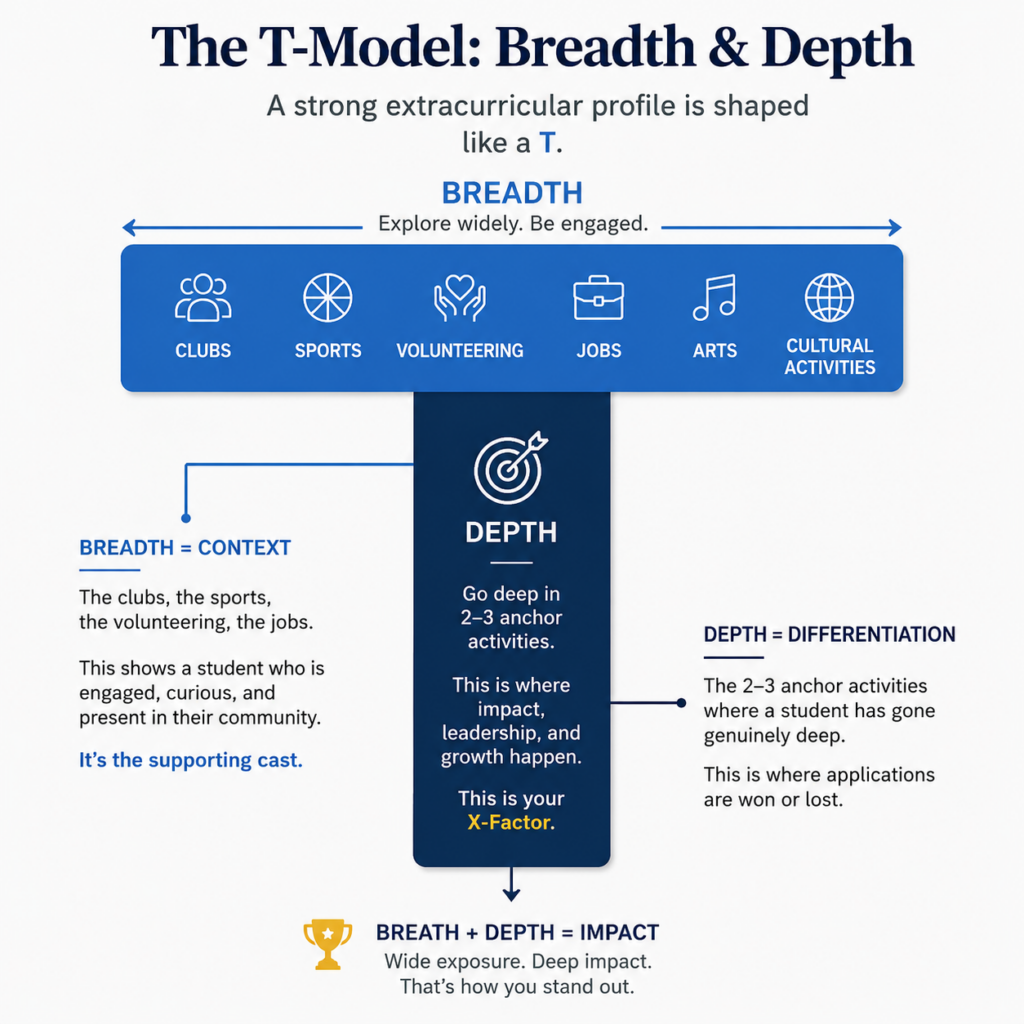
Here’s how I think about a well-constructed extracurricular profile: it should be T-shaped.
The horizontal bar is breadth: the clubs, sports, volunteering, and jobs. This matters. It shows a student who is engaged, curious, and present in their community. But it’s more of the supporting cast that demonstrates how well-rounded they are.
The depth is the vertical bar where applications are won or lost. It’s the 2-3 anchor activities where a student has gone genuinely deep; the Tier-1 experiences that form their X-Factor.
The right balance also depends on where a student is applying.
Competitive programs like Queen’s Commerce and Queen’s Health Sciences often reward extraordinary depth. With only a handful of supplementary application questions, students have limited opportunities to tell their story, which makes having a clear X-Factor even more important.
By contrast, Ivey AEO rewards both depth and breadth. You write about two anchor activities in 500-word essays, while applicants also complete an extracurricular profile and five video interview questions that create additional opportunities to showcase breadth.
When students know where they are applying, they can be more strategic with how they spend their time. If you’re not sure where you’re aiming yet, you generally want to be building both breadth and depth.
What Grade Are You In?
Once I’ve mapped a student’s profile, the next thing I’m thinking about is time. How much runway a student has left changes everything about what’s possible.
Grade 9: Explore
The profile doesn’t really exist yet in any meaningful sense, which means it can be shaped intentionally from the start. This is the time to try things, build breadth, pay attention to what genuinely energizes you, and start asking questions about where the vertical bar might eventually go.
Grade 10: Build
The horizontal bar is likely forming. The work now is identifying where to go deep and starting to build it before the window narrows. One meaningful commitment pursued with real ownership over the next two years is worth more than three additional surface-level activities added to the list.
Grade 11: Scale Impact
There’s less room, but the window isn’t closed. The right Tier-1 commitment, started now and pursued with genuine ownership through Grade 12, can still become an anchor activity by the time applications are submitted. It requires focus and urgency, but it’s absolutely achievable.
Grade 12: Communicate
This is a different conversation, but not a hopeless one. The application can still be told well, and the horizontal bar still has value. But at this stage, you’re translating a history that already exists. You’re no longer building it.
Take a Moment
Think honestly about your student’s profile.
Can you identify their X-Factor? Can you point to 2-3 anchor activities where they’ve gone genuinely deep, where they’ve built, led, or changed something?
If the answer comes quickly, that’s a great sign.
If it doesn’t, don’t panic. Most students aren’t missing potential. They’re missing direction. The earlier you identify the vertical bar of the T, the more time you have to build something meaningful around it.
That’s exactly where we start.
We work with students at every grade level to help them identify, build, and scale their X-Factor. So, if you’re not sure where your child stands, send me a message. I’m always happy to make time for a conversation.
If you found this helpful, be sure to check out my other articles:
The Hardest Conversation I Have with Parents or Rejection-proof applications.